Sponsored
Sponsored
Free Edition
Verified Content
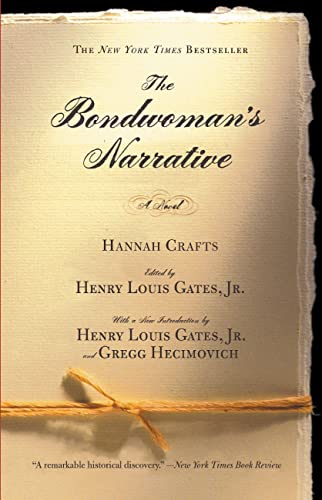
The Bondwoman's Narrative
Overview
The Barnes Noble Review
Through a sequence of fortuitous events detailed in the introduction, noted scholar and author Henry Louis Gates Jr. has discovered what he and others believe may be the first novel written by an African-American woman -- a discovery made even more monumental by the fact that it was found in its original manuscript form, completely unedited. Extensive scientific testing has been completed to authenticate the manuscript and ascertain its origins, and experts agree that it was written between 1853 and 1859, by an African-American woman who had previously been enslaved. Gates has painstakingly sought to identify the author, Hannah Crafts, through historical research, and although he has been unsuccessful in determining her true identity, he has found that many of the places, dates, and characters in the novel can be linked reliably to real events and people.
A riveting story about a young slave woman on a Southern plantation, The Bondwoman's Narrative follows the title character as she escapes and makes her way to freedom. As a novel, it possesses all the charms and devices of popular mid-19th-century fiction, and the influences of gothic and romantic writers popular in the day are apparent throughout the text. But Crafts accomplishes more than mere mimicry in her book, adding her own voice to established traditions to create a unique style.
Throughout the 19th century, many slave narratives -- most notably The Narrative of the Life of Frederick Douglass -- detailed the daily horrors of slavery. In choosing to write a novel rather than an autobiographical narrative, however, Crafts expresses the complete psychological and emotional breadth of the experience, transcending personal, private tortures to illuminate the inhumanity of "the peculiar institution." Her characters reflect upon and feel the experience of enslavement -- and because they are wholly rounded and fully developed, they also express the intellect and insight present in the best writings of Dickens, Poe, or Thoreau.
Discovered dallying in her master's portrait gallery by a white housekeeper, who comments that she is "[l]ooking at the pictures...as if such an ignorant thing as you would know any thing about them," the title character poignantly counters to herself, "Ignorance, forsooth. Can ignorance quench the immortal mind or prevent its feeling at times the indications of its heavenly origins? Can it destroy that deep abiding appreciation of the beautiful that seems inherent to the human soul? Can it seal up the fountains of truth and all intuitive perception of life, death, and eternity? I think not. Those to whom man teaches little, nature like a wise and prudent mother teaches much."
Regardless of its historical importance -- and the unavoidable questions and controversies about its authenticity -- the literary merits of The Bondwoman's Narrative are clear. A deeply engaging novel told with the clarity of a woman who has endured slavery's sorrows and the creativity of one who, at her core, was a gifted artist, it is a powerful story that leaves the reader simultaneously bereft and exhilarated, one that bears witness to the transcendent power of art. (Ann Kashickey)
Through a sequence of fortuitous events detailed in the introduction, noted scholar and author Henry Louis Gates Jr. has discovered what he and others believe may be the first novel written by an African-American woman -- a discovery made even more monumental by the fact that it was found in its original manuscript form, completely unedited. Extensive scientific testing has been completed to authenticate the manuscript and ascertain its origins, and experts agree that it was written between 1853 and 1859, by an African-American woman who had previously been enslaved. Gates has painstakingly sought to identify the author, Hannah Crafts, through historical research, and although he has been unsuccessful in determining her true identity, he has found that many of the places, dates, and characters in the novel can be linked reliably to real events and people.
A riveting story about a young slave woman on a Southern plantation, The Bondwoman's Narrative follows the title character as she escapes and makes her way to freedom. As a novel, it possesses all the charms and devices of popular mid-19th-century fiction, and the influences of gothic and romantic writers popular in the day are apparent throughout the text. But Crafts accomplishes more than mere mimicry in her book, adding her own voice to established traditions to create a unique style.
Throughout the 19th century, many slave narratives -- most notably The Narrative of the Life of Frederick Douglass -- detailed the daily horrors of slavery. In choosing to write a novel rather than an autobiographical narrative, however, Crafts expresses the complete psychological and emotional breadth of the experience, transcending personal, private tortures to illuminate the inhumanity of "the peculiar institution." Her characters reflect upon and feel the experience of enslavement -- and because they are wholly rounded and fully developed, they also express the intellect and insight present in the best writings of Dickens, Poe, or Thoreau.
Discovered dallying in her master's portrait gallery by a white housekeeper, who comments that she is "[l]ooking at the pictures...as if such an ignorant thing as you would know any thing about them," the title character poignantly counters to herself, "Ignorance, forsooth. Can ignorance quench the immortal mind or prevent its feeling at times the indications of its heavenly origins? Can it destroy that deep abiding appreciation of the beautiful that seems inherent to the human soul? Can it seal up the fountains of truth and all intuitive perception of life, death, and eternity? I think not. Those to whom man teaches little, nature like a wise and prudent mother teaches much."
Regardless of its historical importance -- and the unavoidable questions and controversies about its authenticity -- the literary merits of The Bondwoman's Narrative are clear. A deeply engaging novel told with the clarity of a woman who has endured slavery's sorrows and the creativity of one who, at her core, was a gifted artist, it is a powerful story that leaves the reader simultaneously bereft and exhilarated, one that bears witness to the transcendent power of art. (Ann Kashickey)


36,114 currently reading


152,889 want to read
Sponsored
Sponsored
Book details & editions
| ISBN | 0446690295 |
| Publisher | |
| Publication date | January 2002 |
| Language | English (US) |
| Pages | 455 pages |
Sponsored
Sponsored



Ratings & Reviews
5 ★
42%
4 ★
34%
3 ★
16%
2 ★
5%
1 ★
3%
3.92
BlueReads Choice
Sponsored
Write a Review
Community Reviews
Sort by: