Sponsored
Sponsored
Free Edition
Verified Content
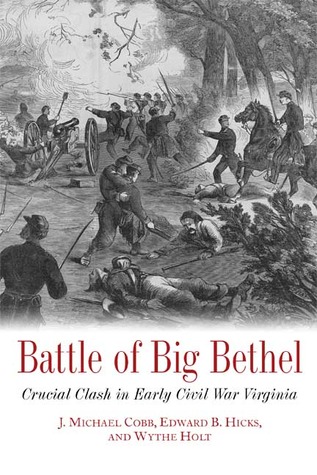
Battle of Big Bethel: Crucial Clash in Early Civil War Virginia
Overview
Battle of Big Crucial Clash in Early Civil War Virginia by J. Michael Cobb, Edward B. Hicks, and Wythe Holt is the first full-length treatment of the small but consequential June 10, 1861, battle that reshaped both Northern and Southern perceptions about what lay in store for the divided nation. In the spring of 1861, many people in the North and South imagined that the Civil War would be short and nearly bloodless. The first planned engagement of the war at Big Bethel, however, provided undeniable evidence of just how wrong popular opinion could be.
Major General Benjamin F. Butler was in command of Union forces at Fort Monroe, Virginia, at the tip of the peninsula between the James and York rivers only ninety miles from the Confederate capital at Richmond. Thanks to the foresight of Lt. Gen. Winfield Scott, President Abraham Lincoln’s elderly chief military adviser, thousands of troops had been assigned to Butler to protect the fort and eventually threaten Richmond, thus perhaps bringing a quick end to the war.
Opposing the Yankees was the aggressive and dramatic Colonel John Bankhead Magruder, who decided to lure Butler into a fight. Magruder fortified a strategic swampy creek crossing, skillfully placed several artillery pieces, selected excellent defensive positions for his 1,400 men, and camouflaged the entire works with brush. Never one to shy away from a challenge, Butler marshaled about 4,000 men for a daring dawn attack.
Although Butler’s forces launched three charges against earthworks well supported by artillery, each was repulsed. Several reasons account for this, including a demoralizing friendly-fire incident, a combination of murderous cannon and musketry, Magruder’s deft handling of his men, the inexperience of the attackers, and poor Union leadership. One of the sterling performances of the day was turned in by Colonel Daniel H. Hill, who ordered his Southern infantry to move across the enemy’s front to retake a forward redoubt.
While the carnage was light compared to later battles, the combat at Big Bethel remained indelibly imprinted on those who fought there. The successful defense reinforced the belief most Southerners held that their martial invincibility and defense of home and hearth were divinely inspired. After initial disbelief and shame, the defeat hardened Northern resolution to preserve their sacred Union. The notion began to take hold that, contrary to popular belief, the war would be difficult and protracted—a conviction that was cemented in reality the following month on the plains of Manassas.
Years in the making, Battle of Big Bethel relies upon letters, diaries, newspapers, reminiscences, official records, and period images—some used for the first time. The authors detail the events leading up to the encounter, survey the personalities as well as the contributions of the participants, set forth a nuanced description of the confusion-ridden field of battle, and elaborate upon its consequences. Here, finally, the story of Big Bethel is colorfully and compellingly brought to life through the words and deeds of a fascinating array of soldiers, civilians, “contraband” slaves, and politicians whose lives intersected on that fateful day in the early summer of 1861.
Major General Benjamin F. Butler was in command of Union forces at Fort Monroe, Virginia, at the tip of the peninsula between the James and York rivers only ninety miles from the Confederate capital at Richmond. Thanks to the foresight of Lt. Gen. Winfield Scott, President Abraham Lincoln’s elderly chief military adviser, thousands of troops had been assigned to Butler to protect the fort and eventually threaten Richmond, thus perhaps bringing a quick end to the war.
Opposing the Yankees was the aggressive and dramatic Colonel John Bankhead Magruder, who decided to lure Butler into a fight. Magruder fortified a strategic swampy creek crossing, skillfully placed several artillery pieces, selected excellent defensive positions for his 1,400 men, and camouflaged the entire works with brush. Never one to shy away from a challenge, Butler marshaled about 4,000 men for a daring dawn attack.
Although Butler’s forces launched three charges against earthworks well supported by artillery, each was repulsed. Several reasons account for this, including a demoralizing friendly-fire incident, a combination of murderous cannon and musketry, Magruder’s deft handling of his men, the inexperience of the attackers, and poor Union leadership. One of the sterling performances of the day was turned in by Colonel Daniel H. Hill, who ordered his Southern infantry to move across the enemy’s front to retake a forward redoubt.
While the carnage was light compared to later battles, the combat at Big Bethel remained indelibly imprinted on those who fought there. The successful defense reinforced the belief most Southerners held that their martial invincibility and defense of home and hearth were divinely inspired. After initial disbelief and shame, the defeat hardened Northern resolution to preserve their sacred Union. The notion began to take hold that, contrary to popular belief, the war would be difficult and protracted—a conviction that was cemented in reality the following month on the plains of Manassas.
Years in the making, Battle of Big Bethel relies upon letters, diaries, newspapers, reminiscences, official records, and period images—some used for the first time. The authors detail the events leading up to the encounter, survey the personalities as well as the contributions of the participants, set forth a nuanced description of the confusion-ridden field of battle, and elaborate upon its consequences. Here, finally, the story of Big Bethel is colorfully and compellingly brought to life through the words and deeds of a fascinating array of soldiers, civilians, “contraband” slaves, and politicians whose lives intersected on that fateful day in the early summer of 1861.
Finding high-quality digital editions shouldn't be a challenge. With instant access to our curated library, you can start your journey with Aftermath immediately. Whether on your phone, tablet, or e-reader, the story of Raleigh's life is presented in a format designed for modern readers.
To get started finding Battle of Big Bethel: Crucial Clash in Early Civil War Virginia, you are right to find our website which has a comprehensive collection of titles listed. Our library is one of the most comprehensive resources for free digital reading materials, providing verified and safe content for book lovers worldwide.


36,114 currently reading


152,889 want to read
Sponsored
Sponsored
Book details & editions
| ISBN | 1611211166 |
| Publisher | N/A |
| Publication date | October 2013 |
| Language | English |
| Pages | pages |
| Reading Options | PDF · EPUB · Mobi |
Sponsored
Sponsored




Ratings & Reviews
5 ★
81.4%
4 ★
14.6%
3 ★
3%
2 ★
0.6%
1 ★
0.4%
4.76
BlueReads Choice
Sponsored
Write a Review
Community Reviews
Sort by:
